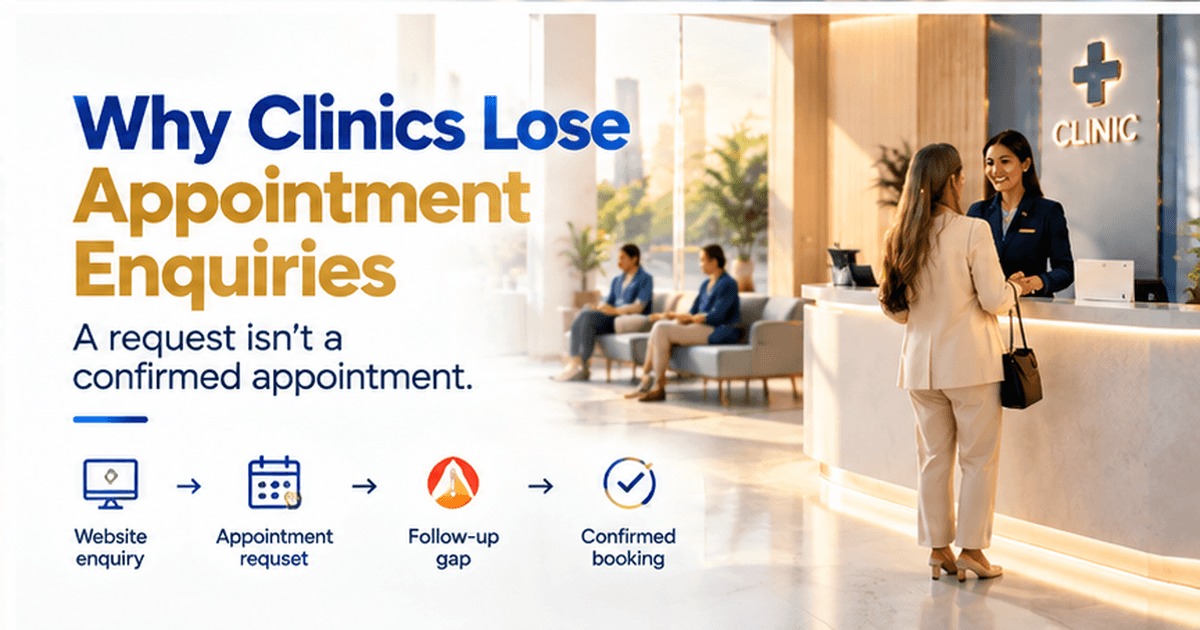

The short answer
Your website gets visitors from search, social media or direct links, but the enquiries are not arriving. Before spending more on ads or rebuilding your website, investigate where the journey breaks. Visitors need to understand your service, trust your business and have a simple way to contact you.
1. Your homepage does not explain the offer clearly
Visitors should quickly understand what you do, who you help and what they should do next. Broad slogans may sound professional without answering those questions.
Replace vague claims with a plain-language description of the service, intended audience and one relevant next step. Clarity matters more than clever wording.
2. Contact options are hard to find
A visitor may be interested but leave when contact links are buried, competing buttons create confusion or the enquiry path disappears on mobile.
Make a contact or project-enquiry action visible in navigation and at natural decision points on important service pages. Avoid adding unnecessary buttons everywhere.
3. Your mobile experience creates friction
Small text, crowded navigation, heavy images and awkward fields interrupt the journey even if the desktop design looks polished.
Test the homepage, service information and contact flow on an actual phone. Check readability, tap targets, loading and whether the task can be completed comfortably.
4. Your enquiry form asks too much
A long questionnaire can discourage someone who only wants an initial conversation. A form that silently fails to deliver submissions can also lose real opportunities.
Ask only for details needed to respond, such as name, contact information, service and a short requirement. Submit a test enquiry and verify both confirmation and delivery.
5. Visitors lack reasons to trust you
Generic promises are less persuasive than accurate business information, a transparent process and clearly identified work examples.
Show real details about how you work and what happens next. Label concept projects honestly and never invent testimonials, results or client relationships.
6. Your traffic does not match your services
High visitor numbers can hide low buying intent. Broad informational searches may attract readers who do not need your paid services.
Compare Search Console queries and landing pages with the quality of actual enquiries. Prioritise content answering questions potential customers ask before hiring a provider.
7. You cannot see where the journey breaks
Page views alone do not tell you whether visitors clicked contact, started a form or submitted it successfully.
Track meaningful actions such as contact clicks and confirmed submissions. Check for duplicate events and combine analytics with usability testing before changing the design.
A 15-minute test to find the exact enquiry bottleneck
Minute 1–3: Open the highest-priority service page on your phone, using a normal mobile connection. Without scrolling much, can you tell who the service is for, what outcome it offers and how to contact the business? Write down every point of uncertainty.
Minute 4–7: Follow the primary call to action. Check whether it opens the intended contact route, whether fields are easy to complete and whether errors explain how to recover. Submit a clearly labelled test enquiry with an address you control.
Minute 8–11: Confirm that the user sees a success message and that the enquiry actually reaches the correct inbox or CRM. A button click or form-start event is not a successful enquiry.
Minute 12–15: Review Search Console queries for that landing page and compare them with your intended buyers. Record one specific fix and a measurement you can compare after release.
Match each symptom to the next action
Many visits but few service-page views: inspect search intent, page title and navigation; compare engaged service-page visits rather than only sessions. Service-page visits but few contact starts: clarify the offer, proof and primary CTA; measure contact-start rate.
Form starts but few confirmed submissions: test required fields, validation, mobile keyboard behaviour and delivery; measure successful submissions, not clicks. Enquiries arrive but few are qualified: review search queries, service descriptions and expectation-setting; measure qualified leads separately from total submissions.
For small sites, a few enquiries can make percentages volatile. Compare consistent periods and check actual lead quality before deciding whether a change worked.
Frequently asked questions
Why is my website getting traffic but no leads? Common causes include irrelevant search intent, an unclear service offer, insufficient trust information, mobile friction or a broken contact path. Test the full journey before paying for more traffic.
Should I redesign my website to get more enquiries? Not automatically. First check whether focused changes to copy, navigation, speed and forms solve the issue. Consider a rebuild when the site architecture makes those improvements impractical.
How do I know whether an enquiry form is working? Submit a test enquiry, confirm the on-screen success state, verify inbox or CRM delivery and check that analytics records one confirmed submission.
Does ranking higher on Google guarantee customers? No. Rankings can bring visibility, but relevant intent, a trustworthy offer and a working follow-up process determine whether visits become qualified enquiries.
What should you fix first?
Start with the clearest obstacle. A broken contact form or inaccessible mobile enquiry action is usually more urgent than decorative changes.
A rebuild may be justified when the structure blocks improvements, but targeted fixes often deserve testing first. Measure qualified enquiries, not raw traffic alone.
The mistake to avoid
Do not assume more traffic, more pop-ups or a complete redesign will solve the problem. Diagnose the issue with testing and verified data. The numbers in the illustrative thumbnail are not actual BrightGrow or client analytics.
Quick checkout audit
1. Can a new visitor understand your service and audience quickly? 2. Is the next step visible on important pages? 3. Can visitors navigate and enquire comfortably on mobile? 4. Does a short test enquiry reach the correct destination? 5. Do you show genuine, accurate trust signals? 6. Do search queries match the services you sell? 7. Can you measure successful enquiries without double counting?
What to do next
The right next step depends on your current situation. Explore BrightGrow’s Website Development service for a clearer plan, or use the project and audit routes on the site to begin a conversation.